
Blog
How to Use AI SEO Tools: Beginner’s Guide to Smarter Search


There’s a version of this guide that just lists tools with star ratings and affiliate links. This is not that version.
This guide is for someone who has heard “AI SEO tools” thrown around everywhere, wants to understand what they actually do, and wants to know how to put them to real use without spending money on something that barely helps.
Let’s start from the actual question.
What Do AI SEO Tools Actually Do?
SEO has always had a data problem. There’s too much of it. Keyword research alone can surface thousands of terms. Content audits can mean going through hundreds of URLs. Competitive gap analysis can take days if you do it manually.
AI SEO tools solve the bottleneck problem. They process large amounts of data fast, identify patterns, and surface what matters. The “AI” part is meaningful because it goes beyond simple rule-based filters. Modern tools use language models to understand context, intent, and meaning, not just exact keyword matches.
What this looks like in practice:
You want to write a blog post targeting “email marketing for ecommerce.” A basic keyword tool gives you search volume. An AI SEO tool can tell you what intent people have when they search that phrase, what subtopics appear across ranking pages, what questions people ask around it, and what your content is missing compared to competitors. That’s a fundamentally different kind of help.
The Main Categories You Need to Know
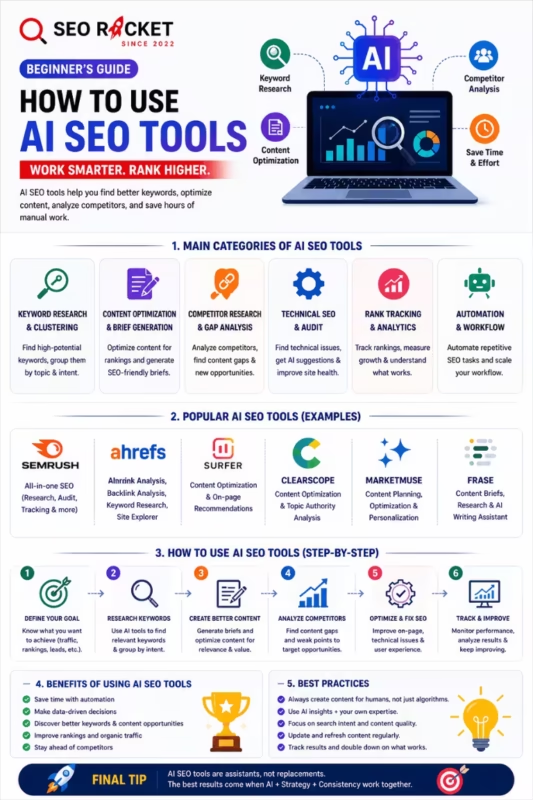
AI SEO tools are not one thing. They fall into a few distinct categories, and beginners often get confused because tools can overlap.
Keyword Research and Clustering
Traditional keyword tools give you a list. AI tools cluster those keywords by topic and intent, so you can build content around themes instead of chasing individual phrases. Tools like Semrush’s Keyword Magic Tool, Ahrefs, and newer AI-native tools like Keyword Insights do this.
Clustering matters because Google ranks pages based on topical authority. Writing ten separate thin posts on ten related keywords is less effective than building one deep resource that addresses an entire topic cluster.
Content Optimization and Brief Generation
These tools analyze what’s already ranking and help you structure your content to be competitive. Surfer SEO and Frase are the most known in this space. You input a keyword, and the tool pulls data from top-ranking pages and tells you what headings to cover, what related terms to include, what approximate word count makes sense.
Used correctly, these tools reduce guesswork. Used blindly, they produce generic content that matches competitors structurally but adds nothing. The tool gives you a skeleton. The thinking and the real insight still has to come from you.
Technical SEO Automation
AI is increasingly being used to flag technical issues at scale. Site crawlers with AI layers can now prioritize issues, estimate their impact, and suggest fixes. Screaming Frog remains the gold standard for raw technical audits, and pairing it with tools like SiteGPT or even using Claude/ChatGPT to interpret crawl exports is a practical workflow many consultants use.
AI Content Writing Tools
This is the category that gets the most attention and the most criticism. Tools like Jasper, Copy.ai, and even direct use of ChatGPT or Claude can generate drafts at speed.
The right frame here: these are drafting tools, not publishing tools. AI-generated content without editing, fact-checking, and genuine original perspective will rank poorly and read poorly. Google’s guidance has been consistent on this. It evaluates the quality and usefulness of content, not the method of production. Good AI-assisted content that’s been properly edited is fine. Bulk AI content with no human layer is a long-term liability.
AI-Powered SEO Auditing
This is the category that has seen the most interesting developments in the last year. The conventional approach here involves tools that accept a URL or a crawl export and produce a generic list of issues ranked by severity. Most of them are white-label products wrapped around GPT-class models with a basic prompt underneath. They look impressive in a demo and produce acceptable output for surface-level audits.
The more capable approach works differently. Instead of relying on a generic tool with a fixed prompt, you bring your audit methodology into Claude directly using a structured SKILL.md file. A SKILL.md is a plain-text instruction file you create once that tells Claude exactly how to conduct a site audit: what sections to cover, how to prioritize issues, what data inputs to expect (Screaming Frog exports, GSC reports, GA4 data), and how to format the final output.
The result is an audit that reflects how you actually work, not how some vendor decided an audit should look. You feed Claude your crawl data and exports, and it follows your framework to produce a structured, prioritized report. For consultants doing client work, this cuts hours off the analysis phase while keeping the output at a standard you’ve defined yourself.
The practical difference shows up in the depth. A generic AI audit tool might flag missing meta descriptions as a high-priority issue across the board. A Claude-powered audit built on a proper SKILL.md will weigh that finding against the page’s organic potential, the competitive landscape of those keywords, and the technical issues that are more likely to be holding back rankings. That kind of contextual prioritization is not something a one-size-fits-all tool can replicate.
If you want to understand how this workflow actually functions, this guide on using Claude SKILL.md files for SEO audits walks through the full process with a real audit framework you can adapt.
Free AI SEO Tools Worth Using
Budget is real, especially when you’re starting. Here are free or freemium options with genuine utility.
- Google Search Console is not “AI” in the traditional sense, but it now has AI-assisted features in some markets. More importantly, it’s the only source of your actual search data. Every other tool is an estimate. GSC is ground truth. If you’re not using it, fix that first.
- Bing Webmaster Tools is underused. It has a free keyword research tool, a site audit feature, and a backlink report. All free.
- ChatGPT (free tier) can assist with keyword brainstorming, content outlining, title tag generation, meta description drafting, and schema markup creation. It’s not an SEO tool in the traditional sense, but for a beginner with limited budget, it can replace several paid tools if used with the right prompts.
- Claude (free tier on claude.ai) is similarly useful for content work, competitive research summaries, and structured SEO tasks. Many practitioners now use Claude specifically because its responses are more nuanced and less prone to confident-but-wrong answers on technical SEO questions.
- Semrush free account gives you limited but real keyword data, 10 keyword lookups per day, and access to some competitive visibility reports. Enough to do directional research when you’re starting.
- Ubersuggest free tier gives keyword volume, difficulty, and content ideas. It has AI writing features on paid plans, but the free keyword data alone is useful.
How to Use These Tools Together: A Practical Workflow
The mistake most beginners make is treating AI SEO tools as a replacement for strategy. They are research acceleration tools. Here is a workflow that actually works.
Step 1: Define the target before you open any tool.
Know who you’re writing for, what they need, and what action you want them to take after reading. AI tools will not tell you this. You have to bring the brief.
Step 2: Do keyword research with search volume context.
Use Semrush, Ahrefs, or even free GSC data to find the primary keyword and its close variants. Look at search intent. Is the query informational (someone learning), commercial (someone comparing options), or transactional (someone ready to buy)? Your content type should match the intent.
Step 3: Analyze what’s currently ranking.
Manually open the top 5 results for your target keyword. Read them. This step is irreplaceable. No tool reads the way a human does. You’re looking for gaps, angles they miss, information that’s outdated, and questions that aren’t fully answered.
Step 4: Use an AI content tool to generate a rough structure.
At this point, use Frase, Surfer, or a direct LLM prompt to generate a content brief or outline. You now have context from step 3, so you can evaluate the AI’s suggestions critically and add what it misses.
Step 5: Write with your own perspective.
Use AI to draft sections where the content is factual and relatively standard. Write the sections that require opinion, original data, or nuanced analysis yourself. Good content in 2025 and beyond needs a perspective that can’t be easily replicated.
Step 6: Optimize before publishing.
Run a final pass through your content brief tool or use a manual checklist. Check title tag length, meta description, internal links, image alt text, and heading hierarchy.
Step 7: Measure and iterate.
Four to twelve weeks after publishing, check GSC for impressions and position data. If a page is showing impressions but low CTR, the title or meta description needs work. If it’s getting clicks but not ranking in the top 10, the content depth or backlinks need attention.
What AI SEO Tools Cannot Do
This section matters more than any tool recommendation.
AI SEO tools cannot build topical authority for you. Authority comes from consistently publishing useful content over time, earning backlinks, and being cited by other credible sources. No tool shortcircuits this.
They cannot replicate first-hand experience. Google’s E-E-A-T update was clear about this. Content that demonstrates real experience, real expertise, and real accountability performs better in competitive niches. AI-generated content has no experience. You do.
They cannot tell you what your specific audience wants. They can tell you what the average search intent looks like across thousands of queries. Your audience may be different. Primary research, customer interviews, and paying attention to comments and questions will always outperform generic intent data for a specific site.
The Honest Summary
AI SEO tools are genuinely useful. They make keyword research faster, content planning more structured, and technical audits more accessible for people who don’t have a consultant budget. The free tools available today are better than paid tools from five years ago.
But they are tools. They extend your capability. They do not replace the judgment, the strategy, or the original thinking that makes a website worth ranking. Beginners who understand this distinction end up

